Cold Calling for Small Businesses: Does It Still Work, and What's Allowed?
 Created with AI
Calling strangers and selling to them: for many small business owners, cold calling is the very definition of uncomfortable sales. But is it still worth it, and what is even allowed? This article gives an honest answer and shows what often works better for a small business. As of July 2026.
Key takeaways
- Cold calling is the first contact with people you have no business relationship with yet, usually by phone.
- Rules differ by country. In Switzerland, business-to-business phone outreach is generally allowed if the number has no opt-out marker and you respect objections; calling private individuals is heavily restricted.
- Honestly, the success rate is low, and for small businesses cold calling is often expensive time.
- For many small businesses it brings more to be found: local visibility, referrals and good content attract customers instead of chasing them.
- If you do call, prepare properly, lead with value instead of a script, and only where it is allowed.
What is cold calling?
Cold calling is the first contact with potential customers you have no business relationship with yet. Classically this happens by phone, but email, post or an unannounced visit are also possible. The goal is to spark interest and get a conversation or an appointment.
The opposite is warm outreach: approaching people who already know you, such as former customers or contacts from your network. Warm outreach is almost always easier, because a basic level of trust already exists.
Is cold calling allowed?
That depends on the country and on whether you call businesses or private individuals. As an example, in Switzerland business-to-business phone outreach is generally allowed under unfair-competition law, as long as the number has no opt-out marker in the directory and you identify yourself correctly and respect any objection. Calls to private individuals are heavily restricted, and some sectors are banned from phone cold calling entirely.
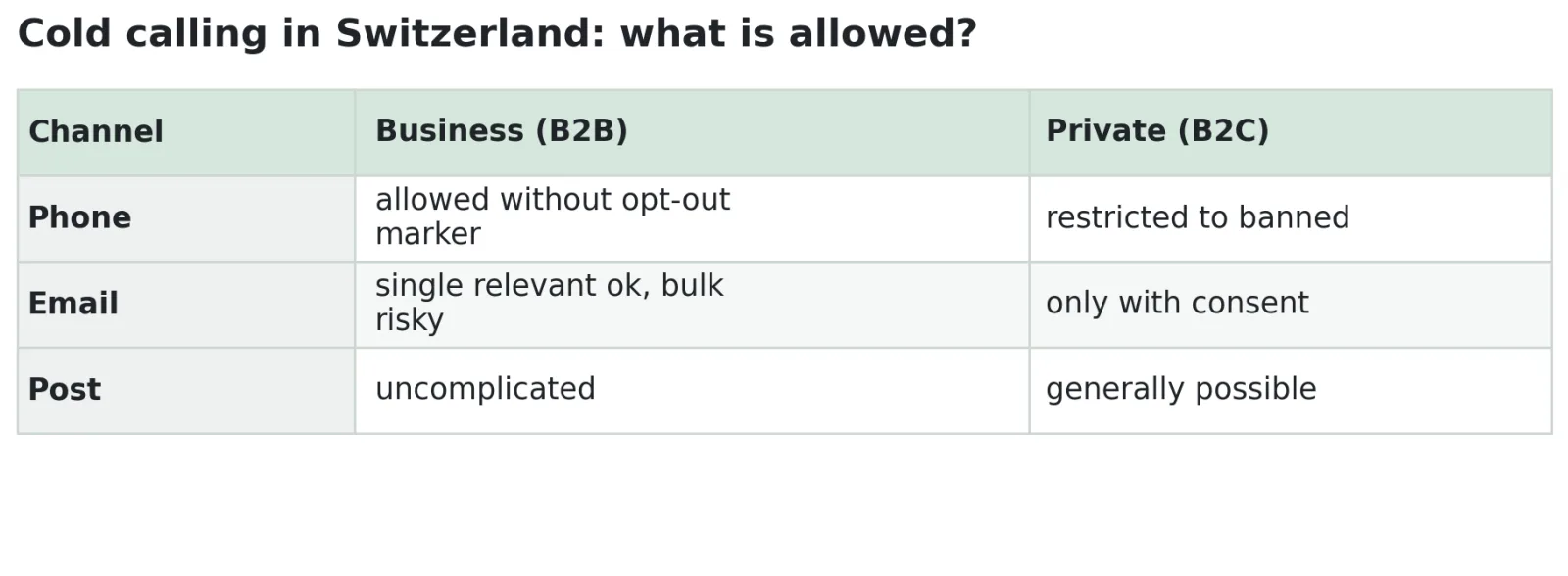
The details differ from country to country, so check your local rules. This article is guidance, not legal advice, and in doubt it is worth getting proper legal input.
Does cold calling still work today?
It works, but the success rate is low and it costs a lot of time. For a large sales team with a clear process it can pay off. For a small business that has to fit outreach in on the side, the cold call is often the most expensive way to new customers, measured in hours per deal.
On top of that, people have grown more sceptical of unsolicited calls. Those who still cold-call need stamina, good preparation and a thick skin. It is doable, but it is rarely the first lever we recommend to a small business.
What often works better for a small business?
Instead of chasing customers, it is more effective for most small businesses to be found. Those who are locally visible, collect referrals and offer helpful content receive enquiries from people who are already interested. These enquiries are warmer and close far more often than a cold call.
The most effective ways for a small business:
- Be found locally: a well-kept Google Business Profile and local search put you in front of people searching right now.
- Referrals: satisfied customers and genuine reviews are the most credible advertising there is.
- Visibility through content: a good website and posts that answer real questions work for you around the clock.
These ways take some building, but they last. How we approach visibility is shown on our page on SEO. And if you want to build customer acquisition predictably, without your own marketing team, our marketing subscription is made for that: fixed hours per month, spent where they bring the most.
If you do cold-call: the most important rules
If cold calling fits your business, for example in clear B2B, then do it well. The difference is in the preparation and the attitude: a real conversation instead of a read-out script.
- Research your audience: approach exactly the people your offer really fits.
- Value, not product: start with the other person's problem, not with your service.
- Listen and keep it short: ask questions, respect their time, get to the point.
- Accept a no: a clean no saves both sides time.
- Stay compliant: follow the rules for your country and channel.
Unsure which way of winning customers fits your business? Get in touch and we will take an honest look.
Frequently Asked Questions
Is cold calling banned?
Not in general, but it is regulated and the rules differ by country. In Switzerland, B2B phone outreach is allowed if the number has no opt-out marker and you respect objections. Calls to private individuals are heavily restricted, and some sectors are banned entirely.
Does cold calling still work today?
Yes, but with a low success rate and high time cost. For small businesses it is rarely the most economical route. Warmer enquiries through visibility and referrals close more often.
What is better than cold calling for small firms?
Being found instead of chasing. A well-kept Google Business Profile, genuine reviews and helpful content bring enquiries from people who are already interested.
May I cold-call private individuals?
Only in a very limited way, and in many places not at all. In practice you are better off avoiding B2C cold calls and using permitted channels instead.
About the author: Sabine is part of es-wirkt, an advertising agency in eastern Switzerland. She writes about SEO, AI visibility (GEO) and digital marketing for small businesses, and helps companies get found in both classic search and AI answers.
This article was edited with AI.