Generative Engine Optimization (GEO): How to Get Your Business Cited by ChatGPT, Perplexity and Google AI
 Created with AI
More and more people ask their questions directly in ChatGPT, Perplexity or the AI answer that now sits at the top of Google search. For a small business, that raises a new question: how do you get into those answers? That is what Generative Engine Optimization is about. This article explains what GEO is and what actually matters for a small company. As of July 2026.
Key takeaways
- GEO (Generative Engine Optimization) gets your content cited in the AI answers of ChatGPT, Perplexity and Google, not just listed in the classic results.
- GEO does not replace SEO, it builds on it: the same website, additionally structured clearly and backed by evidence.
- In 2026, roughly two thirds of Google searches end without a click, and Google's AI overviews reach more than 2 billion monthly users. Visibility inside AI answers matters more than ever.
- The biggest lever for a small business: real customer questions with the answer first, sourced numbers and a clean structure.
- Moving early pays off, because the field still has very little strong content aimed at small businesses.
What is Generative Engine Optimization (GEO)?
Generative Engine Optimization, or GEO, covers everything you do to make your content appear and get cited in the answers of AI systems such as ChatGPT, Perplexity, Google AI Overviews or Gemini. Classic SEO aims for a spot in the list of results. GEO aims to be part of the finished, AI-written answer itself.
In an AI answer, the user gets no list of links, but a ready-made text that summarises a few sources. If you are not among them, you do not exist for that user. And that affects many: Google's AI overviews reach more than 2 billion monthly users, according to Google. The term comes from a 2023 research paper that was the first to study how content can be optimised for generative search.
GEO or classic SEO: what really changes?
GEO does not replace SEO, it builds on it. AI systems crawl the same web pages as Google. If your site is technically clean and thematically clear, you also have the best chances in AI answers. What is new is mainly how content has to be written and structured so that a machine can reliably extract it.
Google itself confirms that good SEO remains the foundation for visibility in AI features. The difference lies in the goal:
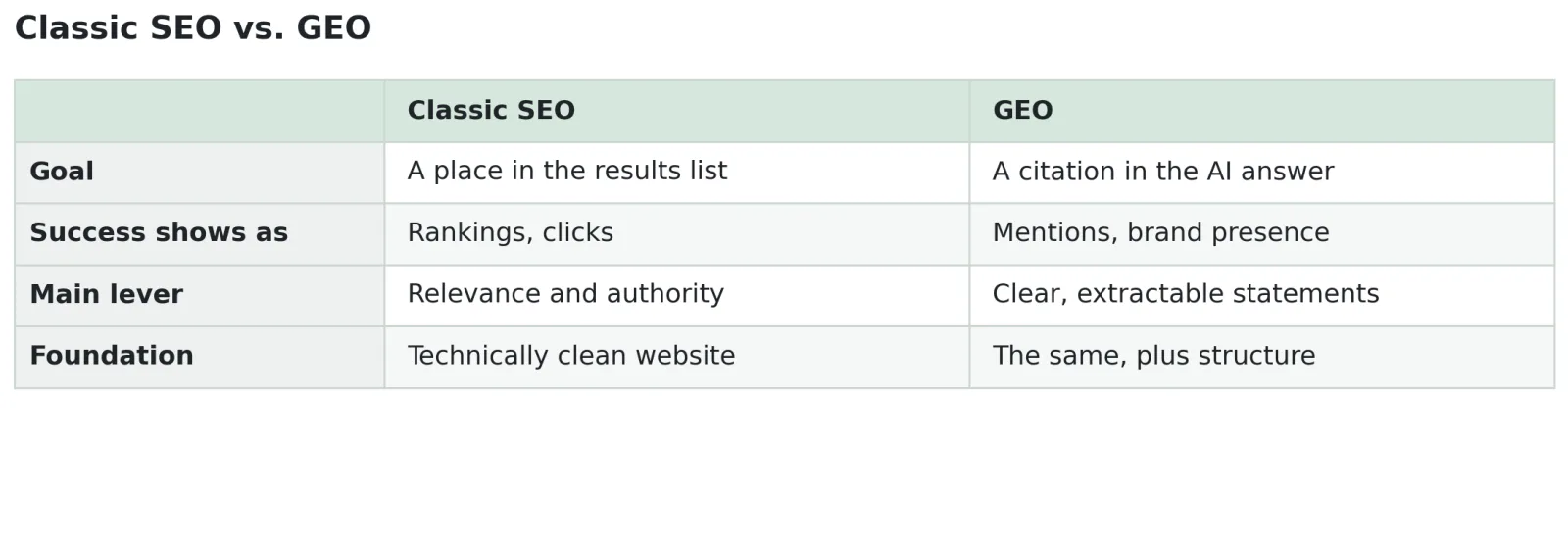
So without solid SEO there is no GEO, and the good news is that most of the work counts twice. How we combine the two is covered on our page on AI SEO and GEO.
How do AI answer engines decide which sources to cite?
AI answer engines favour sources that answer a question clearly, concisely and with evidence. What counts is a single clear key statement near the top, concrete numbers with a source, a clean structure with subheadings, and trust signals such as authorship and recency. The easier a passage is to extract, the more likely it gets cited.
The research paper mentioned above shows that targeted changes such as built-in citations, statistics and clear evidence can raise visibility in AI answers by up to 40 percent, depending on the method. It is not length that matters, but how extractable a passage is. For example: a painting company that writes "your reliable partner for all painting work" gives the AI nothing to hold on to. One that writes "repainting a three-room flat typically costs between 2,000 and 3,500 francs, depending on condition" offers a citable statement and becomes the source. This holds across platforms: whether ChatGPT, Perplexity, Gemini or Google's AI overviews, all favour clearly sourced, well-structured content.
What can a small business do to get cited?
The biggest lever is a question-and-answer structure with the key statement first. If you build your content so that each section fully answers a real customer question, you hand the AI exactly the building blocks it can cite. Six steps that work without a large budget:
- Questions, not slogans: Phrase your subheadings as real customer questions.
- Answer first: Answer each question in the first sentence, then go deeper.
- Numbers with a source: Back claims with concrete figures and a link, invent nothing.
- Spell out entities: Name your company, location and service explicitly instead of just "we".
- Give it structure: Use lists, tables and an FAQ section with structured data.
- Keep it current: Keep dates and facts up to date, AI systems prefer fresh sources.
None of these steps requires expensive technology. It is craft: think clearly, write clearly, cite properly. That is well within reach for a small team, often easier than for a corporation with a sprawling website.
Which content does the AI cite, and which does it ignore?
AI systems reach most readily for clearly bounded, well-structured content: definitions, comparisons, guides, FAQs and sourced numbers. Pure self-promotion with no information value is rarely cited, and so are claims without a source or facts that live only inside an image.
Especially citable are definitions in one or two sentences, comparisons as a table, numbered guides, brief FAQ answers and statistics with a clear source. Rarely cited are pure marketing copy, key statements buried at the end of long paragraphs, facts that sit only in an image, and content with no author, date or source. The strongest lever for a small business is your own primary knowledge: real price ranges, case examples or experience from your field cannot be invented by an AI, so it cites your source.
How do I know whether I show up in AI answers?
Ask the AI systems the exact questions your customers ask, and check whether and with which source your business appears. Repeat this regularly in ChatGPT, Perplexity and Google's AI. For a start, manual spot checks are enough; for systematic measurement there are specialised monitoring tools.
Consistency is what matters, because AI answers change constantly. Write down ten to fifteen typical questions and check them monthly, for example. Watch who else is named, too: your competitors in the AI answers show you which content is working right now and where your biggest gap is.
Is GEO worth it for a small company already?
For most small businesses the answer is yes, but with a sense of proportion. Search volumes around GEO are still small in the German-speaking market, but they are rising clearly, and the field is barely occupied. Whoever is set up cleanly now gets cited before competitors even try.
Why it pays off shows in how people search: in 2026, roughly two thirds of Google searches end without a click on a result (an analysis by SparkToro based on Similarweb data). More and more often, customers get their answer directly in search or in an AI chat. GEO does not replace SEO fundamentals or a good website, it is the logical next layer on top. For a purely local business the effort stays small today; for anyone who wants to be visible beyond their region or online, an early start pays off.
What actually makes sense for you, we will tell you honestly, without panic and without hype. Get in touch and we will take an honest look at where your business stands in AI answers.
Frequently Asked Questions
What does GEO mean?
GEO stands for Generative Engine Optimization. It covers every measure that helps your content appear and get cited as a source in the answers of AI systems such as ChatGPT, Perplexity or Google AI Overviews.
Does GEO replace classic SEO?
No. AI systems crawl the same web pages as Google, so technically and editorially clean SEO remains the foundation. GEO builds on it and additionally optimises how content is written and structured so an AI can cite it.
How do I get into the answers of ChatGPT and others?
Answer real customer questions clearly and concisely, with the key statement first, back numbers with sources, and give your content a clean structure with subheadings and an FAQ. The easier a passage is to extract, the more likely it is cited.
Is GEO a separate item or part of SEO?
In practice GEO belongs closely to SEO. Many measures overlap, such as clean structure and recency. It makes sense to plan both together rather than as separate projects.
Is GEO worth it for a small business?
For most, yes, with a sense of proportion. Search volumes are still small but rising clearly, and the field is barely occupied. Whoever is set up cleanly early gets cited before competitors catch up.
About the author: Sabine is part of es-wirkt, an advertising agency in eastern Switzerland. She writes about SEO, AI visibility (GEO) and digital marketing for small businesses, and helps companies get found in both classic search and AI answers.
This article was created with AI.