You're outside the EU. Does the AI Act still make you label your content?
 Created with AI
If you run a small business outside the EU, you probably assume the EU AI Act is not your problem. Often it is. From 2 August 2026, new transparency rules for AI content apply, and they can reach a company in Switzerland, the UK or the US just as much as one in Germany. This article explains, calmly and precisely, when the rules apply to you and what you actually have to label. As of July 2026.
Key takeaways
- The EU AI Act can apply to you even if your company sits outside the EU, based on where your content reaches people.
- Most small businesses are deployers, not providers. The technical watermarking duty (paragraph 2) usually does not apply to them.
- AI marketing texts are generally not labelling-required if a human reviews and takes responsibility for them.
- AI images only need a label when they look realistic enough to pass as a genuine recording.
- The transparency obligations of Article 50 apply from 2 August 2026.
Does the EU AI Act apply to a company outside the EU?
Yes, if your AI-generated content reaches the EU market. The Act follows a market-location principle: once AI content is published or made available to people in the EU, the rules apply, regardless of where your company is based. What matters is not your address, but where the content takes effect.
In practice, a Swiss, UK or US business with EU customers, an EU-language landing page or EU-wide ads is affected. A purely local business with no EU audience is generally not. A simple test helps: do my AI contents deliberately reach people in the EU? If yes, plan for disclosure from the start. Almost every internationally active small business faces this question, and few answer it clearly.
What changes on 2 August 2026?
On 2 August 2026, Article 50 of the EU AI Act (Regulation (EU) 2024/1689) becomes applicable. It sets transparency duties: certain AI content must be recognisable as such. This does not cover all use of AI, but clearly defined cases such as chatbots, deepfakes and certain published texts. Purely internal use with no publication is not covered.
One deadline has shifted: the technical, machine-readable marking by providers applies to systems already on the market only from 2 December 2026. Because such deadlines keep being adjusted, it is worth checking the current status before any major decision.
Are you a provider or a deployer?
This is the most important distinction in the whole topic. Whoever develops and supplies an AI system is a provider. Whoever merely uses a finished AI tool is a deployer. Almost every small business is a deployer, and deployers have clearly different duties from the makers of the tools.
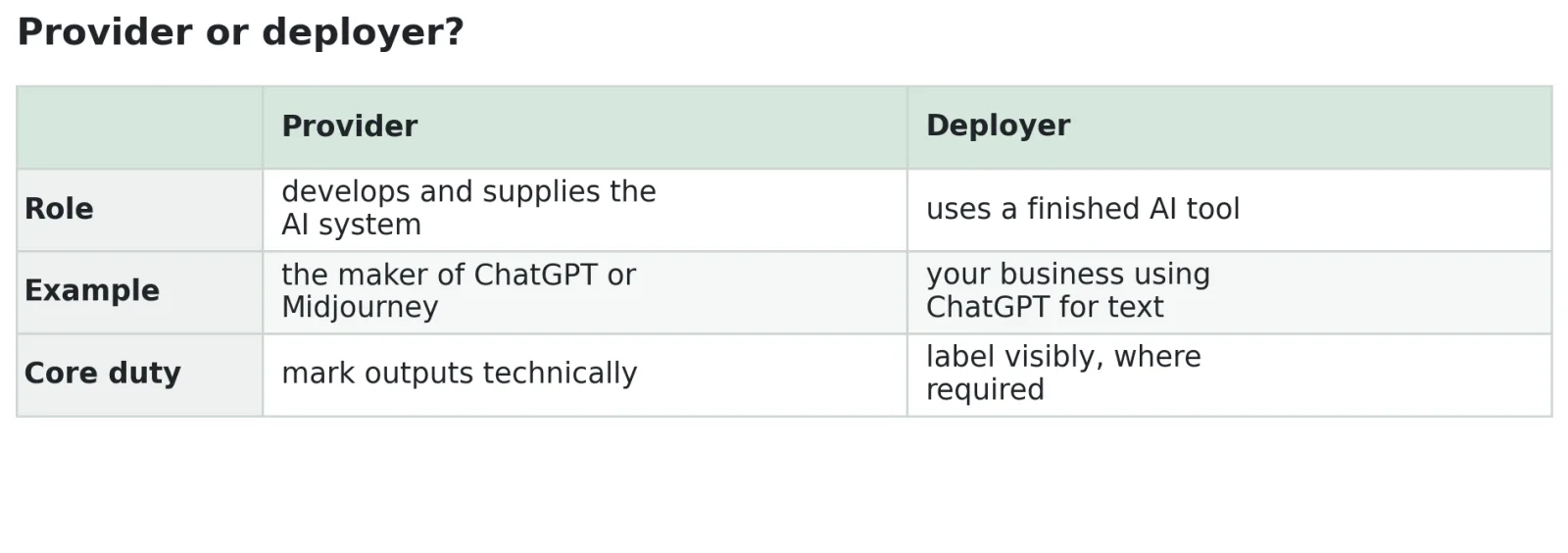
This matters because much of the alarmist coverage describes the technical watermarking duty. That duty is aimed at providers, not at you as a deployer. There is one exception: if you heavily rebuild an AI system, change it substantially or resell it under your own name, you may legally become a provider yourself. For normal use of finished tools like ChatGPT or Canva, you remain a deployer.
Which duties come from Article 50?
Article 50 contains not one but four separate duties, and almost all competing articles blur them. The point is that most of them affect you as a small business only partly, or not at all. This overview untangles them:
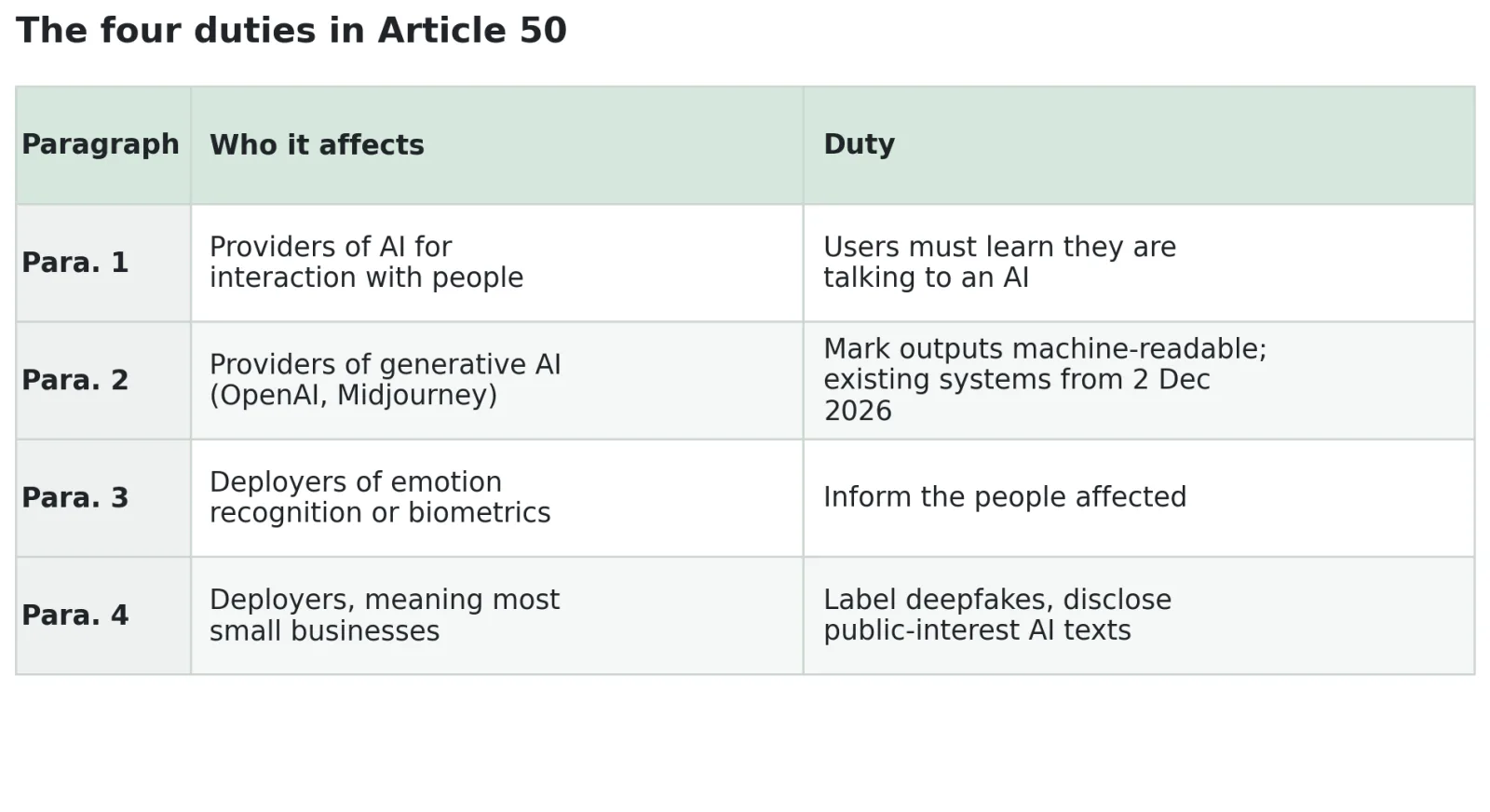
For a typical small business, paragraph 4 is almost the only one that counts. Paragraph 2, the one everyone writes about, does not apply to you as long as you only use AI rather than act as a provider. The details are in the text of Article 50. One special case: if you run an AI chatbot, you must make sure users can tell they are chatting with a machine, and there is no grandfathering for chatbots that have been running for a while.
Do I have to label my AI marketing texts?
In most cases, no. The duty in paragraph 4 only bites for texts on matters of public interest, such as contributions on socially or politically relevant topics. Pure product promotion and a company's own communication generally fall outside it. On top of that, the duty falls away with genuine editorial control.
Editorial control means a human checks the text before publication for accuracy, plausibility and sources, with a real ability to change or reject it, and a clearly identifiable person or company takes responsibility. The line matters: merely skimming it or running a spell check is explicitly not enough. A blog text drafted with ChatGPT about your service, reviewed and signed off by a responsible person, is free. An auto-generated guide on a contested public issue that nobody proofreads would be risky.
Do I have to label AI images?
It depends on how realistic they are. The dividing line runs along realism: anything that looks deceptively like a real person, place or event counts as a deepfake and must be labelled. Obviously artificial or clearly stylised images do not. The idea behind it is protection against deception: AI itself is not forbidden, only the false impression of a genuine recording.
There is generally no duty for a stylised logo, an abstract graphic, a comic-style product mock-up or an obviously artistic illustration. A label is required for the realistic photo of a fictional person, an AI-generated stock photo of a meeting, or anything that could pass as a real recording. If you use AI for realistic images or video, a clear internal rule pays off. On the production side, our page on AI-assisted image and video helps.
How should the label look?
Clear, obvious and recognisable to humans. A note only in the technical metadata is not enough: the label must be understandable to the average viewer, at the latest on first contact with the content. There is no fixed rule for wording or design.
In practice, a short, visible note such as "Made with AI" directly on the image or under the post is enough. The EU also provides standard icons you can use. We disclose AI assistance transparently ourselves, for example with a short note on the post, because disclosure builds trust rather than just ticking a box. What matters is that the label does not disappear into the small print.
What happens if you don't label?
Honestly, the legal picture here is less clear-cut than many articles suggest. The regulation names fines of up to 15 million euros or 3 percent of worldwide annual turnover for breaches of transparency duties. Whether Article 50 is directly subject to fines, however, is judged differently by different experts.
Some see concrete consequences only in combination with competition and consumer-protection law, and through reputational damage. We are not lawyers and will not resolve that dispute; we name it. Scaremongering with a contested maximum figure would be exactly the mistake we criticise in others. This covers the EU rules only. Your national rules may add more, so for a specific case, take legal advice. A pragmatic way to show good faith is the voluntary Code of Practice on the transparency of AI content: not mandatory, but a recognised means of demonstrating compliance.
Your checklist before 2 August
The good news: the effort for a small business is manageable. These five steps get you ready, each doable in a sentence.
- AI inventory: Note which tools produce which content for you (text, image, chat).
- Check the chatbot: Does a chatbot clearly say it is an AI? There is no grandfathering for chatbots.
- Review images: Which of your AI images are realistic enough to fall under the deepfake rule?
- Assign editorial responsibility: Who reviews AI texts, who is responsible, where is that documented?
- Adjust contracts and briefings: Do your agency and freelancers deliver labelled material where needed?
Labelling is ultimately the regulatory side of a bigger shift: trust in digital content is becoming more valuable. Those who are transparent win. The same is true for visibility itself, for instance when it comes to being found by AI search like ChatGPT. How we bring transparency and findability together is covered under AI SEO and GEO.
This article is editorial guidance, not legal advice. For a specific case, especially with chatbots, deepfakes or EU market access, a lawyer should be consulted. Unsure what falls under the duty in your case? Get in touch and we will take an honest look.
Frequently Asked Questions
When does the AI labelling duty start?
The transparency obligations of Article 50 of the EU AI Act become applicable on 2 August 2026. The technical marking by providers applies to systems already on the market only from 2 December 2026.
Do I have to label AI-generated marketing texts?
In most cases, no. The duty only applies to texts on matters of public interest, not to pure product communication. It also falls away when a human reviews and takes responsibility for the text. Merely skimming it is not enough.
Do I have to label AI-generated images in advertising?
Only if they are realistic enough to pass as a genuine recording. A stylised logo or comic illustration is free; a deceptively real photo of a fictional person or an AI stock photo of a meeting must be labelled.
Does the EU AI Act also apply to companies outside the EU?
Yes, as soon as AI-generated content is made available on the EU market. The market-location principle applies, so your company's location does not matter. A business outside the EU with EU customers or EU ads is affected; a purely local one is generally not.
What happens if I don't label?
The regulation names fines of up to 15 million euros or 3 percent of worldwide annual turnover. Whether Article 50 is directly subject to fines is judged differently by experts. Realistically, consequences come mainly through competition and consumer-protection law and reputational damage.
About the author: Sabine is part of es-wirkt, an advertising agency in eastern Switzerland. She writes about SEO, AI visibility (GEO) and digital marketing for small businesses, and helps companies get found in both classic search and AI answers.